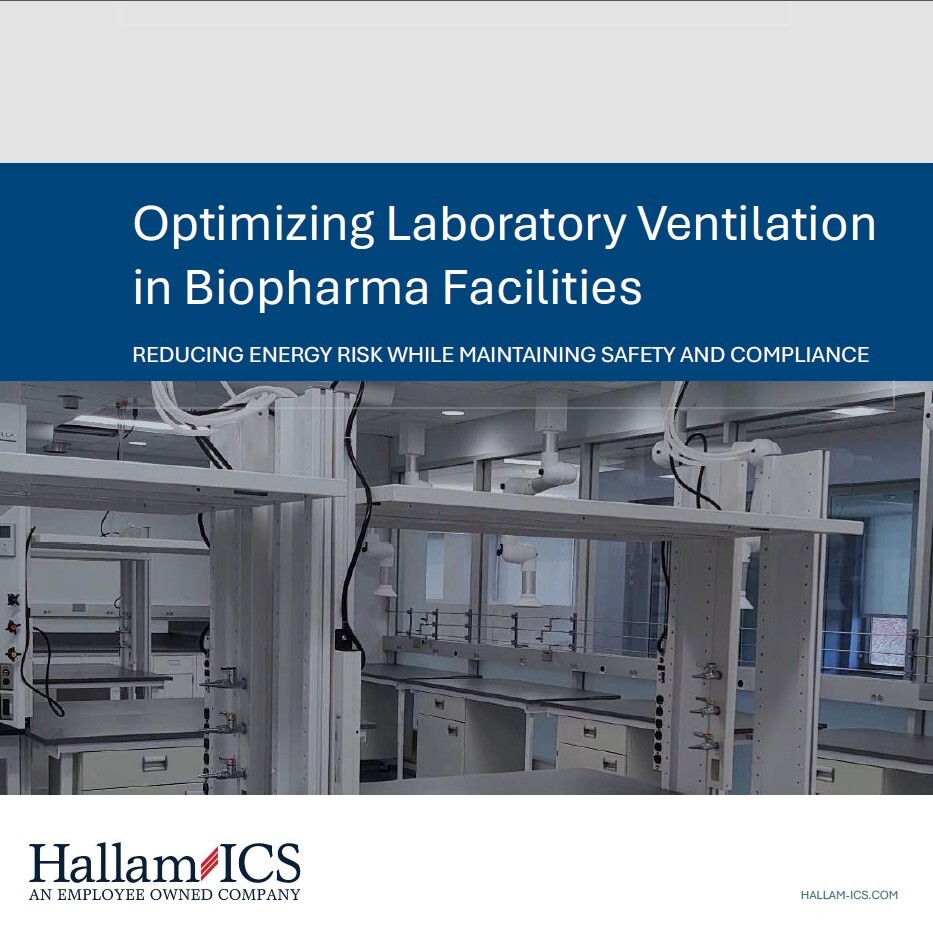

Optimizing Laboratory Ventilation in Biopharma Facilities
Reducing Energy Risk While Maintaining Safety and Compliance
Biopharma facility owners face a major operating cost challenge in laboratory ventilation, where high air change rates, 100% outside air systems, and continuous exhaust can drive significant energy use, utility cost, and carbon impact. In many biopharma laboratories, traditional ventilation strategies still rely on fixed air change rates that run continuously regardless of occupancy, hazard level, or actual room activity. While this conservative approach is intended to support laboratory safety and regulatory compliance, it can also increase HVAC energy consumption, oversize infrastructure, and create unnecessary long-term operating cost across research, development, and manufacturing support facilities.
A modern laboratory ventilation strategy uses risk-based ventilation, demand-controlled ventilation (DCV), and energy recovery to align airflow with actual laboratory conditions instead of worst-case assumptions. Current industry guidance increasingly supports performance-based ventilation design over prescriptive fixed air change rates, helping owners reduce fan energy, heating energy, and cooling energy while maintaining safety, compliance, and containment performance. For biopharma facilities, this approach can improve energy efficiency, reduce lifecycle cost, support decarbonization goals, and increase flexibility for both new construction and existing laboratory retrofits.
Reduce laboratory HVAC energy consumption using risk-based and demand-controlled ventilation strategies
Maintain laboratory safety, compliance, and containment performance while lowering operating costs
Support decarbonization goals and improve flexibility for both new biopharma facilities and laboratory retrofits