
by Catherine Walter on Jun 2, 2026, 10:30:01 AM
Introduction
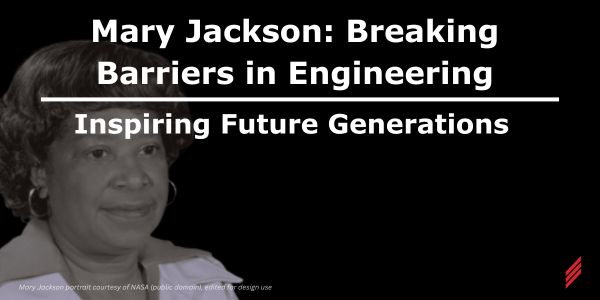
Mary Jackson once said:
“We have to do something like this to get them interested in science. Sometimes they are not aware of the number of Black scientists, and don’t even know of the career opportunities until it is too late.”
Mary Jackson broke barriers as NASA’s first African-American female engineer, paving the way for future generations in STEM.
Early Life and Education
Born in 1921 in Hampton, Virginia, Jackson excelled academically from an early age. She later earned a dual bachelor’s degree in mathematics and physical science from Hampton Institute (now Hampton University).
Before beginning her engineering career, she worked in several roles, including teaching, bookkeeping, and administrative positions.
From NACA Computer to NASA Engineer
In 1951, Jackson joined the National Advisory Committee for Aeronautics (NACA) at Langley Memorial Aeronautical Laboratory as a “human computer” in the segregated West Area Computing division.
These “human computers,” many of whom were women, performed complex mathematical calculations by hand to support aeronautical research.
Her career took a turning point when engineer Kazimierz Czarnecki invited her to work in the Supersonic Pressure Tunnel, a 60,000-horsepower wind tunnel used to study airflow at high speeds.
To advance, Jackson was required to attend graduate-level classes held at a segregated high school. She successfully petitioned the city of Hampton for permission to attend.
In 1958, she became NASA’s first African-American female engineer and went on to author multiple reports on boundary layer effects at supersonic speeds, contributing to advancements in aerospace engineering.
Advocacy and Lasting Impact
Later in her career, Jackson shifted her focus from engineering to advocacy.
In 1979, she accepted a role in NASA’s Equal Opportunity programs, where she became Langley’s Federal Women’s Program Manager. She worked to support the advancement of women and minorities in STEM, helping others access opportunities that had once been denied to her.
Her story, later shared more broadly through the book and film Hidden Figures, remains a powerful reminder that engineering thrives when barriers are removed and opportunities are expanded.
Why Her Legacy Still Matters
On International Women in Engineering Day, Mary Jackson’s legacy continues to inspire future engineers to challenge expectations and create space for those who follow.
Her contributions go beyond technical achievements, they reflect the importance of access, representation, and persistence in shaping the future of engineering.
Part of our Women in Engineering series:
About the Author
Catherine Walter is an Engineering Intern at Hallam-ICS, supporting the engineering team with a focus on dust hazard analysis. She is a rising senior at North Carolina State University, where she is studying Mechanical Engineering.
About Hallam-ICS
Hallam-ICS is an engineering and automation company that designs MEP systems for facilities and plants, engineers control and automation solutions, and ensures safety and regulatory compliance through arc flash studies, commissioning, and validation. Our offices are located in Massachusetts, Connecticut, New York, Vermont and North Carolina and our projects take us world-wide.

How to become an engineer
How My Job at Hallam-ICS Changed Me (for the better!)
No Comments Yet
Let us know what you think