
by Cassie Mallabar on Jun 23, 2026, 10:30:01 AM
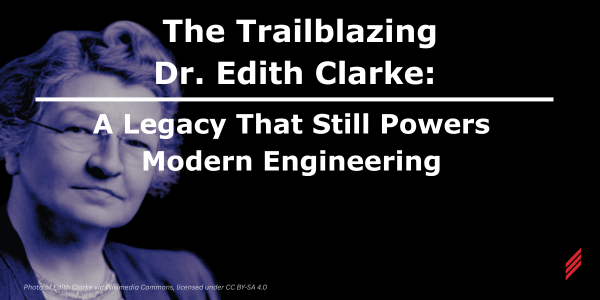
“There is no demand for women engineers, as such, as there are for women doctors; but there's always a demand for anyone who can do a good piece of work.” – Edith Clarke
Why Edith Clarke Still Matters Today
In 1883, the idea of a woman pursuing engineering was nearly unheard of. Today, women continue to shape the future of engineering, but the path was paved by pioneers like Dr. Edith Clarke.
As we recognize International Women in Engineering Day, it’s worth reflecting on Clarke’s impact, not just as a trailblazer, but as an engineer whose work still influences how modern power systems are designed, analyzed, and operated.
A Career Defined by Firsts
Edith Clarke’s journey into engineering was anything but conventional.
After earning a mathematics degree from Bryn Mawr College, she went on to become the first woman to earn a degree in electrical engineering from MIT in 1919.
Despite her credentials, she initially struggled to find work as an engineer. She began her career at General Electric as a “computer,” performing complex calculations by hand, work that was critical but often undervalued.
Her persistence paid off:
- First professional female electrical engineer in the U.S. (GE, 1922)
- First woman to present a paper to the American Institute of Electrical Engineers
- First female full voting member of AIEE
- First female engineering professor in the U.S. (University of Texas, 1947)
Clarke didn’t just enter the field; she helped redefine it.
The Clarke Calculator: Solving a Critical Engineering Challenge
In the early 20th century, one of the biggest challenges in electrical engineering was long-distance power transmission.
Designing these systems required complex calculations for:
- Impedance
- Voltage drop
- Alternating current (AC) behavior
These calculations were time-consuming and prone to error.
In 1921, Clarke developed the Clarke Calculator, a graphical tool that simplified these calculations and made them significantly faster and more accurate.
This innovation enabled engineers to design more reliable and efficient transmission systems, accelerating the expansion of electrical infrastructure.
How Clarke’s Work Shaped Modern Power Systems
Clarke’s contributions continue to influence the systems engineers rely on today:
Long-Distance Transmission
Her work made it feasible to deliver power across large geographic areas, laying the foundation for modern electrical grids.
System Efficiency
Engineers could optimize designs to reduce losses and improve performance, a principle still central to today’s energy systems.
Reliability and Safety
Accurate calculations improved system stability and helped establish safety practices that are still in use.
Scalability
Her innovations made it possible to interconnect systems, supporting the large-scale, integrated grids we depend on today.
From Clarke’s Work to Today’s Engineering Challenges
While the tools have evolved, from graphical calculators to advanced modeling software, the core challenge remains the same:
turning complex data into reliable, real-world systems.
This is where Clarke’s legacy still shows up.
At Hallam-ICS, engineers solve similar challenges every day, whether it’s designing power monitoring systems, improving electrical safety, or integrating complex control systems. The tools are more advanced, but the need for accuracy, clarity, and practical problem-solving hasn’t changed.
A Legacy That Goes Beyond Engineering
Edith Clarke’s impact isn’t limited to her technical achievements.
Her career highlights an ongoing reality: engineering benefits from diverse perspectives, yet representation remains a work in progress. Her success demonstrated that innovation isn’t defined by background, it’s defined by capability and persistence.
Carrying That Legacy Forward
As a woman working in electrical engineering today, I see Clarke’s influence not just in textbooks or historical milestones, but in the systems, standards, and safety practices that guide my work.
Her contributions helped build the foundation for modern electrical engineering and created opportunities for the next generation of engineers to step forward.
At Hallam-ICS, that legacy continues through the engineers solving today’s challenges and building the systems that power critical industries.
Part of our Women in Engineering series:
About the Author
Cassie graduated in 2020 from the University of Vermont with a BS in electrical engineering, and has been working with the Arc Flash team ever since. Originally from Vermont, she now works out of the North Carolina office, where she is a true joy to have around. Outside of work, she likes walks through nature and listening to music. She would love for you to ask her about her cat, Billy Strings, and his many toes.
About Hallam-ICS
Hallam-ICS is an engineering and automation company that designs MEP systems for facilities and plants, engineers control and automation solutions, and ensures safety and regulatory compliance through arc flash studies, commissioning, and validation. Our offices are located in Massachusetts, Connecticut, New York, Vermont and North Carolina and our projects take us world-wide.

Beatrice Hicks: Engineering Reliability Beyond Earth and Into Modern Systems

The Benefits of Turnkey Engineering Solutions: One Partner from Design to Commissioning

No Comments Yet
Let us know what you think