
by Nabil Salloum, PE on Jan 15, 2026, 10:30:00 AM
Is Passive House Only for Homes?
A common question we hear from engineers working on commercial and institutional design is:
“Why do we need to learn about Passive House? Isn’t it only for residential buildings?” It’s a fair assumption, the word “house” can be misleading, but Passive House is not a building type.
Passive House is a performance standard focused on energy efficiency, indoor air quality, and occupant comfort.
Its core principles can be applied to any building including offices, hospitals, schools, laboratories, and universities.
Let’s explore how Passive House design works for non-residential buildings, why it’s being adopted across U.S. codes, and what engineers should understand to apply it effectively.
Global Examples of Passive House Beyond Housing
Engineers around the world are demonstrating how Passive House can scale from homes to high-performance commercial facilities.
Winthrop Center, Boston, MA
• Largest Passive House certified office building in the world (~810,000 ft²)
• 700-ft-tall skyscraper operating at ~65% less energy and carbon than typical LEED Platinum offices
Wood Innovation Research Laboratory - British Columbia, Canada
• ~13,000 ft² industrial-scale research lab built entirely in mass timber
• North America’s first Passive House lab
LfL Nossen Laboratory - Saxony, Germany
• ~50,000 ft² of research and administrative space
• Demonstrates Passive House feasibility even with high ventilation laboratory loads
Klinikum Frankfurt Höchst Hospital - Frankfurt, Germany
• World’s first Passive House hospital (~840,000 ft²)
• Maintains extremely low air infiltration despite 24/7 HVAC demands
.png)
These projects highlight one clear message: Passive House is not limited by building type. It is driven by performance and occupant comfort.
Why Passive House Matters in U.S. Codes
As the U.S. moves toward electrification and decarbonization, Passive House is being written into state and local regulations as a pathway to compliance. Many codes now refer to passive house or PHIUS as an approved or even required path.
Examples of current adoption include:
- Massachusetts: Stretch Code & Opt-In Specialized Code (large residential > 12,000 ft² must meet PHIUS)
- Maine: Statewide Stretch Code
- New York: NY Stretch
- Chicago: Alternate Compliance Path
- Oregon: Residential Reach Code
- Colorado, Washington, Pennsylvania: growing adoption in local ordinances
Notably in Massachusetts, large residential buildings >12,000 ft² in Opt-In communities must meet PHIUS requirements. Understanding Passive House performance metrics is increasingly important for mechanical engineers designing systems to meet these evolving codes.
What Is Passive House?
Passive House is a building standard focused on minimizing energy consumption while maximizing indoor comfort, durability, and air quality. The principles apply from multifamily to academic buildings.
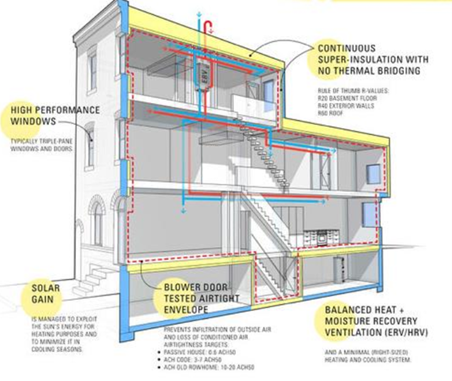
Source: https://phmass.org/
Achieving certification requires close collaboration between architectural envelope design and mechanical engineering.
Core Passive House Principles
Thermal Control
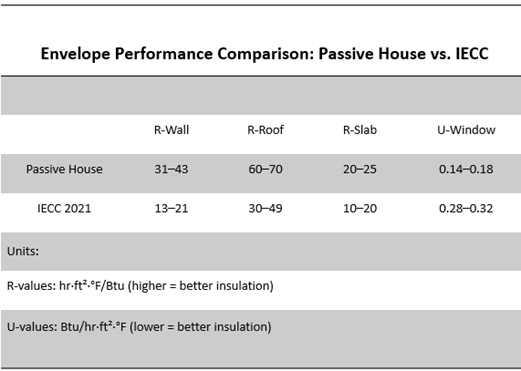
High-performance insulation and glazing maintain consistent interior temperatures and reduce HVAC load.
Thermal Bridge Elimination
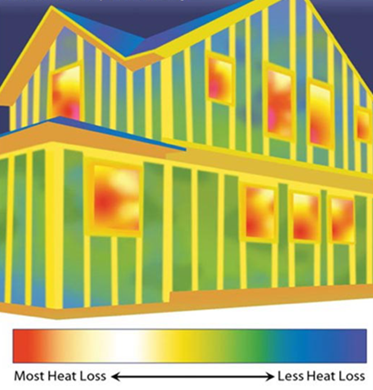
Thermal bridge is a break in insulation continuity or junctions, so even small weaknesses in insulation can undermine performance. Eliminating Thermal bridging will enhance:
- Energy efficiency
- Interior surface temperatures
- Moisture safety and mold resistance
- Occupant comfort
Source: https://www.phius.org/
Continuous Control Layers
Every assembly must include four continual barriers:
- Air Barrier: prevents leakage
- Vapor Barrier: controls water vapor diffusion
- Thermal Control: reduces heat flow
- Water Control: sheds bulk water
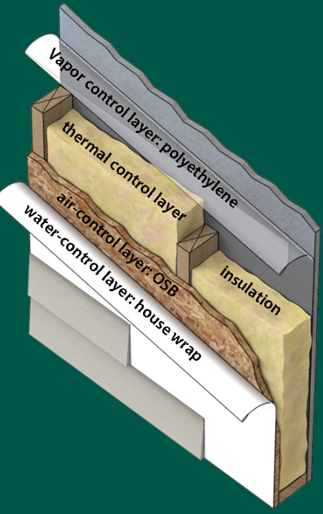
Source: https://www.phius.org/
High-Performance Mechanical Design
Mechanical systems in Passive House buildings typically feature:
- Balanced ventilation with 80%+ heat or energy recovery
- All-electric heat pumps for heating and cooling
- Heating Load calculations that include internal gains
- Ultra-low infiltration (< 0.06 CFM/shell area @ 50 Pa)
- Energy modeling (WUFI, METR) to ensure compliance
The result: smaller, more efficient systems and 30–45% lower carbon emissions than MA Stretch Code baselines.
Understanding PHIUS and Its Role
Founded in the U.S. in 2007, the Passive House Institute U.S (PHIUS) certifies North America projects and tailors performance targets to each U.S. climate zone.
PHIUS differs from the German PHI standard that its Climate-specific performance targets by U.S. climate zone ensuring cost-effective and regionally appropriate designs.
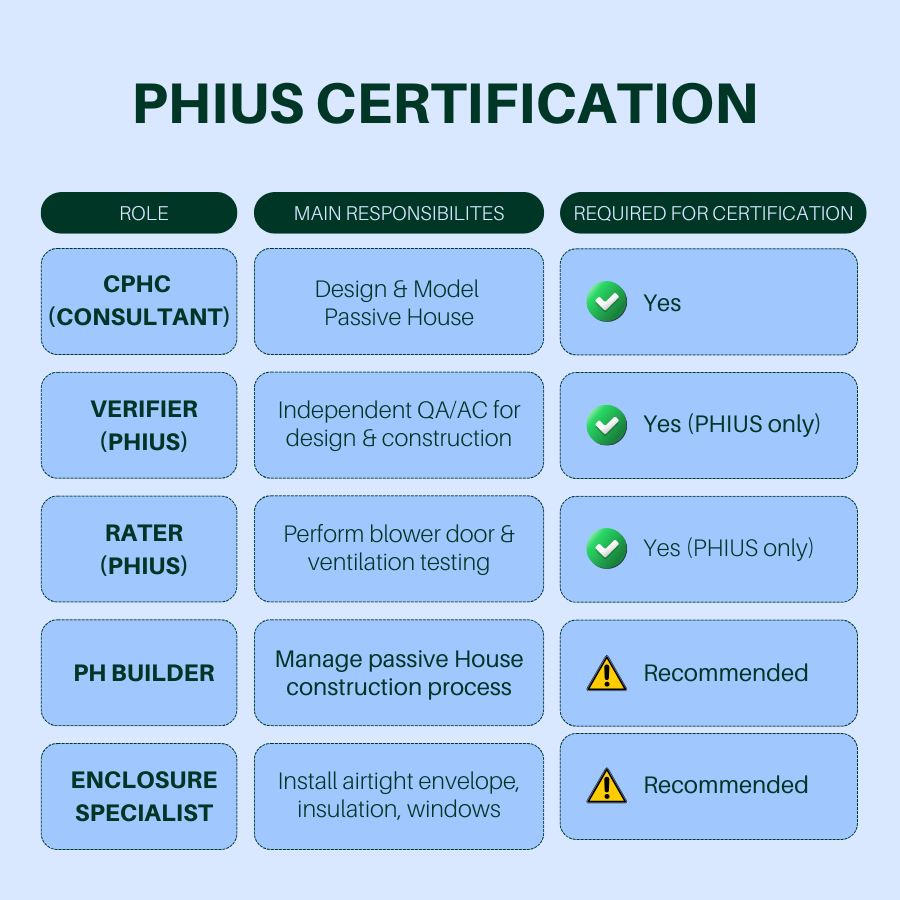
PHIUS certification is implemented through multiple trained professionals including consultants, verifiers, raters, and builders, working together to ensure measurable performance and quality assurance.
Is Passive House More Expensive?
According to the latest PHIUS research, PHIUS buildings typically cost only 2–3% above conventional construction.
With market experience and optimized design, this gap continues to shrink and state incentive programs can reduce it even further.
The Future of Passive House in Commercial Design
Passive House is no longer a niche concept, it is rapidly becoming a mainstream engineering practice. As building codes increasingly prioritize carbon emissions, electrification, and measurable Indoor Air Quality improvements, PHIUS provides a proven pathway to compliance and superior operational performance.
From hospitals and laboratories to offices and campuses, Passive House delivers:
- Consistent indoor comfort
- Lower operating costs
- Healthier environments
- Long-term resilience
For engineers, understanding and applying PHIUS principles today positions your projects, and your clients, for a low-carbon future.
Next Steps
If your team is exploring high-performance design or preparing for upcoming energy code changes, Hallam-ICS can help integrate Passive House mechanical strategies and energy modeling into your next project.
Explore more about our MEP and building performance engineering expertise ›
About the Author
Nabil joined Hallam-ICS in 2025 with over 20 years of HVAC design and construction experience. A licensed Professional Engineer and certified Passive House consultant, he values Hallam’s employee-ownership culture and commitment to doing things the right way.
Read My Hallam Story
About Hallam-ICS
Hallam-ICS is an engineering and automation company that designs MEP systems for facilities and plants, engineers control and automation solutions, and ensures safety and regulatory compliance through arc flash studies, commissioning, and validation. Our offices are located in Massachusetts, Connecticut, New York, Vermont, North Carolina and Texas and our projects take us world-wide.


Commissioning Lessons Learned – Communication!

Impacts of Working for a Safety Conscious Company

No Comments Yet
Let us know what you think