
Northeastern University - Kostas Cleanroom Process Engineering Support
We approach our work from a Whole Facility Design Perspective, resulting in elegant, efficient engineering solutions that are practical and reliable, maximizing your long term benefit from your facility.
Challenge
Hallam-ICS was hired to provide process engineering support for semiconductor research in the Egan Building at Northeastern University’s Boston campus. Northeastern principal investigators planned to install several new semiconductor research tools which required more than 10 high purity and high hazard gases. The hazard categories of the necessary gases were toxic, corrosive, flammable, and pyrophoric. To safely and code compliantly house the necessary high hazard gases, the multidisciplinary team designed an H-5 occupancy space. Through careful coordination, detailed discussions with researchers, and thorough surveys of the building, the high hazard room was added to the existing building without significant disruptions to its other occupants.
Solution
To define the scope of the hazardous gas installation, we met with the principal investigators, lab managers, EH&S personnel, and tool manufacturers. We needed to determine how much of each gas was necessary and where they could be stored in the building. Based on the number of gases and the quantity of each which was necessary, the project’s storage needs exceeded the maximum allowable quantity (MAQ) as defined by NFPA 55, 2020. To store quantities above MAQ, the International Building Code (IBC) requires the use of a high hazard occupancy, commonly referred to as an H-rated space. Since these gases were being stored for the purpose of use in semiconductor research and development, we selected the H-5 occupancy designation as our compliant code path.
Process Design
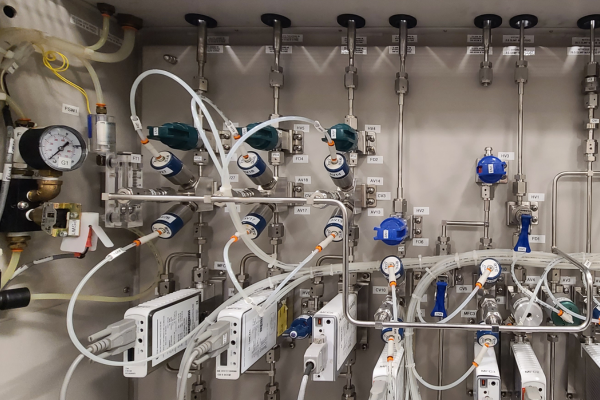
The H-5 gas room was a 2-hour rated fire resistant room with high and low exhaust. To safely store the high hazard gases, they were each placed into a fully automated and exhausted gas cabinet. The exhaust from each cabinet was routed through a catastrophic abatement scrubber. These scrubbers are designed to capture the entire contents of a leaking cylinder to avoid creating a hazardous environment outside of the building. Each joint of the ultra-high purity stainless steel process gas piping was orbitally welded from the outlet of the gas cabinets to the inlets of the tool gas manifold boxes. For health hazard gases (corrosives and toxics), the gases were routed in double containment piping. The space between the inner and outer piping was pressure monitored by each of the gas cabinets. If the carrier pipe ever leaked, it would be contained by the containment pipe, and the gas cabinet would detect the leak and shut off the flow of gas.
Low Vapor Pressure
One of the gases, boron trichloride (BCL3) has a relatively low vapor pressure at ambient temperatures. This means that the gas has the potential to condense into a liquid inside the pipe. To avoid this potential condensation, heat trace wiring and insulation were added to the pipe to keep it above the temperature where BCL3 could condense. To help vaporize and push the BCL3 out of its cylinder, the cylinder was equipped with a heating jacket.
A Unique Hazard
One of the gases needed by the researchers was silane, SiH4. Silane is pyrophoric which means that it can auto-ignite at room temperature when exposed to oxygen. Because of this unique hazard and its ubiquitous use in the semiconductor industry, silane has its own safety code, CGA-G13. One of the key safety features implemented for silane is the use of ultraviolet / infrared (UVIR) flame detection inside the gas cabinet. If silane were to leak within the ventilated gas cabinet and ignite, the UVIR detector would activate, and the automatic cylinder valve would stop the flow of gas from the cylinder.
Toxic gas monitoring design
As a critical safety measure for the storage and use of high hazard gases, a hazardous gas monitoring system was installed in the gas storage room and in the clean room where the tools were located. This is an automatic system that constantly samples the air for hazardous gases. Detection points were placed in the gas cabinet exhausts, in open air near the tools, and in the tool gas manifold boxes. Our design included a document called the cause and effects matrix. This matrix details the reactions toto a detection in a particular location. The responses to a detection range from a warning light, or shutting off the flow of gas, to a building evacuation.
Summary
Hallam-ICS provided process engineering support for Northeastern University’s semiconductor research facilities in the Egan Building. The project involved designing a code-compliant H-5 hazardous gas storage room to support new research tools requiring more than 10 high-purity, high-hazard gases. The design included fire-rated construction, exhausted gas cabinets, catastrophic abatement scrubbers, and ultra-high purity stainless steel piping. Additional safeguards addressed specific hazards, including double containment for toxic and corrosive gases, heat tracing for boron trichloride, and UV/IR flame detection for silane. A hazardous gas monitoring system was also incorporated to detect releases and trigger appropriate safety responses, helping protect researchers, building occupants, and the surrounding facility.
Results
Our team accomplished the following:
- The project required a compliant H-5 occupancy space because the quantity and hazard classification of the gases exceeded NFPA 55 maximum allowable quantity limits.
- The high hazard gas room was designed with 2-hour fire-rated construction, high and low exhaust, automated exhausted gas cabinets, and catastrophic abatement scrubbers to contain and control potential gas releases.
- Ultra-high purity stainless steel process gas piping was orbitally welded, with double containment and pressure monitoring used for corrosive and toxic gases to reduce leak risk and enable automatic shutoff.
- Boron trichloride required special design measures, including heat tracing, insulation, and a heated cylinder jacket, to prevent condensation caused by its low vapor pressure.
- Silane required dedicated safeguards because it is pyrophoric, including UV/IR flame detection inside the gas cabinet and automatic cylinder valve shutoff if ignition is detected.