Challenge
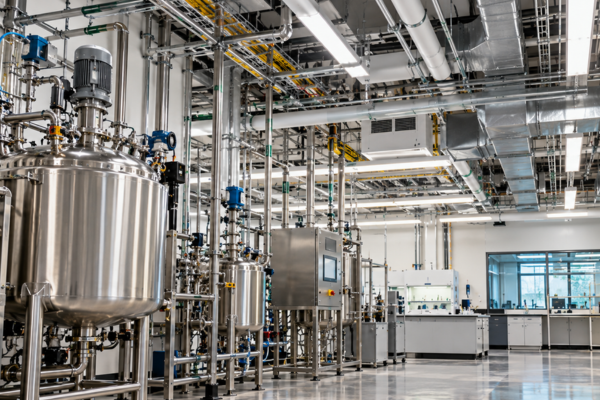
A confidential Life Sciences client needed to relocate a standalone, five-hopper continuous mixer from an overseas facility to an existing U.S. R&D laboratory utilizing active pharmaceutical ingredients.
The primary challenge was fitting the specialized equipment within the existing laboratory footprint. Vertical clearance was constrained by the ceiling height and mezzanine configuration, and the project team needed to develop the design before the equipment had been unboxed. Installation planning therefore relied on OEM documentation, shipping data, and dimensional verification. Design Suggestion Edited
The initial approach was to modify the equipment to fit the existing space. That would have required shortening equipment legs, reconfiguring stairs and mezzanine platforms, coordinating structural steel modifications, and managing additional OEM approvals and fabrication.
Further evaluation showed that this seemingly less invasive approach would introduce longer lead times, greater coordination requirements, and additional commissioning and validation risk. Design Suggestion Edited
Solution
Hallam-ICS conducted an extensive feasibility study to compare alternative installation approaches based on cost, schedule, constructability, and long-term operational risk.
As part of the feasibility process, engineers and architects performed detailed field investigation of the existing facility. The team accessed the ceiling space using lifts to verify structural framing, utilities, congestion, and available clearances before construction. Design Suggestion Edited
Rather than modifying the process equipment, the team determined that raising the ceiling and adjusting the architectural volume would allow the mixer to be installed as designed.
Although this approach initially appeared more disruptive, it eliminated custom equipment modifications and associated OEM fabrication, approval cycles, structural and access changes, and expanded commissioning and validation requirements. Construction could instead be organized into defined, predictable phases with fewer dependencies. Design Suggestion Edited
Engineering, architecture, and construction remained engaged throughout the project, allowing assumptions to be tested and potential solutions evaluated based on their impact on the overall project rather than on a single discipline. Design Suggestion Edited