Unexpected equipment failure is one of the costliest challenges industries face today. Whether in manufacturing plants, power facilities, or large commercial buildings, unplanned downtime can halt operations, disrupt supply chains, and lead to expensive repairs. For maintenance and reliability teams, identifying problems before they become failures is essential to improving uptime and controlling costs.
Understanding Infrared Thermography
Infrared thermography is a diagnostic technique that uses specialized cameras to detect heat emitted by objects. Every piece of equipment gives off Infrared Radiation as a function of its temperature. Thermal cameras capture this radiation and convert it into visual images, allowing technicians to see temperature variations that would otherwise be invisible to the human eye.
These temperature differences are often early indicators of problems. For instance, excessive heat in an electrical panel might signal a loose connection, while an overheating bearing could indicate friction or lubrication issues. By identifying these anomalies early, thermography enables proactive intervention.
From Reactive to Predictive Maintenance
For decades, maintenance strategies fell into two categories: reactive and preventive. Reactive maintenance involves fixing equipment only after it breaks, which often leads to costly downtime and emergency repairs. Preventive maintenance, on the other hand, relies on scheduled servicing regardless of the equipment’s actual condition. While better than reactive approaches, it can still result in unnecessary work and wasted resources.
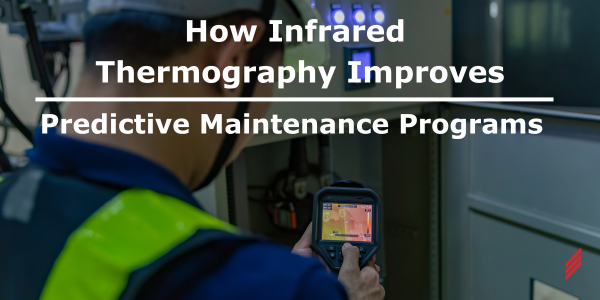
Predictive maintenance represents a more efficient alternative. Instead of relying on fixed schedules, it uses real-time data to determine when maintenance is actually needed. Infrared thermography plays a crucial role in this shift by providing immediate, non-invasive insights into equipment health. Technicians can monitor systems during normal operation, making it possible to detect faults without interrupting productivity.
Benefits of Infrared Thermography in Predictive Maintenance
- Early fault detection – Identify electrical and mechanical issues before failure occurs.
- Reduced downtime – Perform inspections while equipment remains in service.
- Improved safety – Assess energized and high-temperature equipment from a safe distance.
- Lower maintenance costs – Prevent major failures and optimize maintenance schedules.
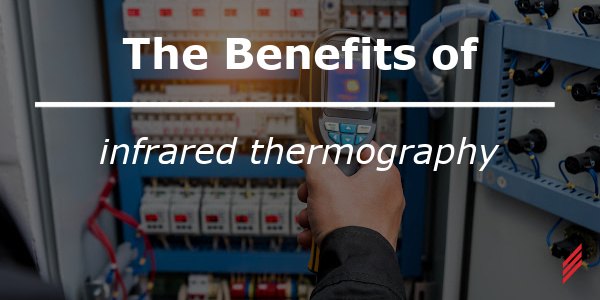
These advantages help maintenance and reliability teams shift from reacting to failures to proactively managing equipment health. By providing early insight into developing problems, infrared thermography supports better maintenance planning, improved system reliability, and more efficient use of maintenance resources.
Real-World Applications
Infrared thermography is used across a wide range of industries including:
- Manufacturing – Monitor motors, pumps, bearings, and conveyor systems for signs of wear, imbalance, or overheating.
- Power Generation and Distribution – Inspect transformers, switchgear, substations, and transmission equipment for developing electrical faults.
- Renewable Energy Systems – Identify underperforming solar panels and other components that may impact system efficiency.
- Commercial Facilities and HVAC Systems – Detect electrical issues, insulation deficiencies, and HVAC performance problems before they affect building operations.
Limitations and Considerations
Despite its many advantages, infrared thermography is not without limitations. Accurate results depend on proper technique and interpretation, which requires trained professionals. Environmental factors such as ambient temperature, wind, and reflective surfaces can also influence readings. For this reason, thermography is most effective when used in combination with other diagnostic tools and maintenance practices.
The Future of Infrared Thermography
As technology continues to evolve, infrared thermography is becoming even more powerful. Integration with smart sensors, automation systems, and data analytics platforms is enabling continuous monitoring and real-time alerts. In some cases, artificial intelligence is being used to analyze thermal data and predict failures with even greater accuracy.
For maintenance and reliability teams, these advancements provide earlier visibility into developing issues and support more informed maintenance decisions.
In an era where efficiency and reliability are essential, infrared thermography is helping organizations stay ahead of potential problems. By turning heat into actionable insight, it transforms maintenance from a reactive necessity into a strategic advantage—one that keeps operations running smoothly and costs firmly under control.
Frequently Asked Questions about Infrared Thermography
What is infrared thermography used for in predictive maintenance?
Infrared thermography is used to identify abnormal heat patterns in electrical and mechanical equipment that may indicate developing faults, wear, or inefficiencies.
Can infrared thermography be performed while equipment is running?
Yes. One of the primary advantages of infrared thermography is that inspections can often be performed while equipment remains in operation, reducing downtime and disruption.
What types of equipment benefit from thermal imaging inspections?
Common applications include electrical panels, motors, pumps, bearings, transformers, switchgear, HVAC equipment, and solar energy systems.
Does infrared thermography replace other predictive maintenance tools?
No. Infrared thermography is most effective when used alongside other predictive maintenance techniques such as vibration analysis, oil analysis, and equipment condition monitoring.
Next Steps
Infrared thermography is one of many tools organizations use to improve equipment reliability and reduce unplanned downtime. When incorporated into a broader predictive maintenance strategy, thermal inspections can help maintenance teams identify developing issues earlier and make more informed maintenance decisions.
If your facility is evaluating predictive maintenance technologies or looking to strengthen an existing reliability program, Hallam-ICS can help assess your current approach and identify opportunities for improvement.
About the author
Bryan Campbell is a Professional Engineer for Hallam-ICS with a focus in electrical power. He has spent his career performing arc flash and infrared thermography studies in a variety of industries including Pharmaceutical, Industrial, Food and Beverage as well as Higher Education. His areas of expertise include SKM, AutoCAD and Revit.
Read My Hallam Story
About Hallam-ICS
Hallam-ICS is an engineering and automation company that designs MEP systems for facilities and plants, engineers control and automation solutions, and ensures safety and regulatory compliance through arc flash studies, commissioning, and validation. Our offices are located in Massachusetts, Connecticut, New York, Vermont, North Carolina, and Texas and our projects take us world-wide.

No Comments Yet
Let us know what you think