by Wayne Catucci on Oct 15, 2026, 10:30:01 AM
In laboratory retrofit projects, teams often gravitate toward what appears to be the least invasive solution. Architectural changes may be treated cautiously, while equipment modifications can seem more contained, controllable, and safer from a schedule standpoint.
But the smallest apparent scope does not always deliver the lowest overall cost, schedule, or risk.
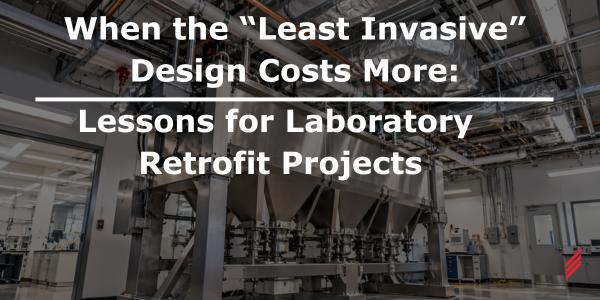
A recent R&D laboratory project illustrates why. The project team was evaluating how to install specialized process equipment within an existing laboratory. The seemingly conservative solution was to modify the equipment to fit the space. A broader feasibility evaluation ultimately showed that modifying the space instead would provide a cleaner and more predictable path.
The result was an approximately 20% reduction in total project cost and installation of the equipment within a 12-week project schedule. More importantly, the process reinforced several lessons that can help owners and project teams evaluate similar retrofit decisions.
1. Don’t Assume the Least Invasive Laboratory Retrofit Is the Lowest-Risk Option
When new equipment does not fit neatly within an existing facility, modifying the equipment may seem like the logical first choice.
In this case, the project involved a standalone, five-hopper continuous mixer being relocated from an overseas facility to a U.S. R&D laboratory utilizing active pharmaceutical ingredients. The primary constraint was vertical clearance relative to the existing ceiling height and mezzanine configuration. Complicating matters further, design had to proceed before the equipment was unboxed, using OEM documentation, shipping data, and dimensional verification.
One option was to modify the equipment by shortening its legs, reconfiguring stairs and mezzanine platforms, coordinating structural steel adjustments, and managing the associated OEM approvals and fabrication.
On the surface, this approach minimized changes to the building. But looking at the full project impact revealed additional considerations: custom fabrication and OEM approval cycles introduced longer lead times, structural and access modifications increased coordination requirements, and bespoke equipment changes increased validation and commissioning risk.
What appeared to be the less invasive solution was actually more fragile from a cost and schedule perspective.
The lesson: Evaluate the risk created by a solution, not simply the amount of visible construction it requires.
2. Put Flexibility Where It Creates the Most Value
Instead of asking only, “How can we modify the equipment to fit the room?” the team considered a different question:
What if the room changed to accommodate the equipment?
The alternative was to raise the ceiling and adjust the architectural volume so the mixer could be installed as designed.
Initially, this appeared to be the more disruptive option. Raising a ceiling suggested broader construction work and greater coordination. Viewed holistically, however, it provided a cleaner and more predictable construction path.
Placing flexibility in the building rather than the process equipment eliminated an entire chain of downstream work associated with custom equipment alterations.
The lesson: In retrofit design, don't assume the existing facility must remain fixed. Evaluate where flexibility can be introduced most effectively, within the equipment, the building, or supporting infrastructure.
3. Invest in Feasibility Before Committing to a Laboratory Retrofit Solution
Choosing between these approaches required more than comparing construction scope.
The project team conducted an extensive feasibility study, evaluating multiple pathways across cost, schedule, constructability, and long-term operational risk.
That required additional engineering effort upfront, but it reduced the likelihood of reactive decisions later in the project. Rather than committing early to the option that appeared simplest, the team had the information needed to evaluate which alternative delivered the greatest overall value.
Field investigation was an important part of that process.
Engineers and architects jointly accessed the ceiling space using lifts to review existing structure, utilities, and clearances. Structural framing and congestion were verified before construction, allowing constructability to be evaluated based on actual field conditions rather than assumptions.
That becomes particularly important in retrofit projects, where unknown existing conditions can quickly become drivers of schedule delays and cost growth.
The lesson: Time spent eliminating unknowns during feasibility can prevent much more expensive decisions during construction.
4. Evaluate Total Project Impact, not Just First Cost
A meaningful comparison between retrofit alternatives should consider more than the construction cost associated with each option.
The right solution depends on more than construction cost. Schedule, constructability, equipment implications, commissioning and validation requirements, and operational risk all contribute to overall project value.
In this project, raising the ceiling avoided OEM equipment modification and fabrication risk, extended approval cycles and lead times, complex coordination between the equipment, platforms, and access systems, and expanded validation and commissioning scope.
Instead, construction could be concentrated into defined and predictable phases with fewer dependencies.
The results included:
- Approximately 20% reduction in total project cost
- 12-week project delivery, significantly faster than equipment-modification alternatives
- Reduced commissioning and validation exposure
- Equipment installed as designed, without permanent compromise
.png)
The project also achieved greater schedule certainty, an outcome that can be just as important as first-cost savings when critical research equipment and ongoing operations are involved.
Collaboration Makes Better Alternatives Possible
Decisions like these rarely belong to one discipline.
Engineering, architecture, and construction were engaged throughout this project, with regular site involvement and open collaboration. As feasibility work progressed, assumptions were tested, findings were validated, and potential solutions were refined collectively.
That multidisciplinary perspective allowed the team to compare alternatives based on total project impact rather than optimizing one piece at the expense of another.
Change the Right Thing
Value engineering in laboratory retrofit projects should not simply mean minimizing visible scope or selecting the option that initially appears least disruptive.
Sometimes a larger change on paper can produce a cleaner, faster, and more reliable project outcome.
The key is determining what should change.
By investing in feasibility, investigating existing conditions, comparing alternatives across the entire project lifecycle, and engaging the appropriate disciplines early, owners can make those decisions with greater confidence and place flexibility where it delivers the most value.
See how these principles were applied in practice in our R&D Laboratory Equipment Installation case study.
For more on planning flexible laboratory environments, explore Hallam-ICS's approach to laboratory design and renovation.
About the author
Wayne Catucci is a Lead Mechanical Engineer and Project Manager at Hallam-ICS with more than 13 years of experience in HVAC and mechanical engineering. He specializes in the planning, design, and delivery of laboratory, biopharmaceutical, and other highly regulated facilities, helping owners balance safety, reliability, energy efficiency, and lifecycle cost.
Read My Hallam Story
About Hallam-ICS
Hallam-ICS is an engineering and automation company that designs MEP systems for facilities and plants, engineers control and automation solutions, and ensures safety and regulatory compliance through arc flash studies, commissioning, and validation. Our offices are located in Massachusetts, Connecticut, New York, Vermont, North Carolina, and Texas, and our projects take us world-wide.

Flexible Pharmaceutical Lab Design: 5 Strategies for Future-Ready Facilities
Preparing to Lead in an Employee-Owned Company: Lessons from My Time at Darden

No Comments Yet
Let us know what you think